Almost every contractor knows reviews matter. Very few have anything you could honestly call a system for getting them. What most trades businesses actually have is a good intention, which is that when things are calm and someone remembers, they ask a customer to leave a review, and then work gets busy and the asking quietly stops for four months.
That gap between knowing and doing is why a business with eleven years of excellent work and genuinely happy customers can sit on six reviews while a newer competitor down the road has thirty-eight and takes the calls. The difference is almost never the quality of the work. It is that one of them built a review generation system for contractors that runs whether anyone is thinking about it or not, and the other one relies on remembering.
This guide is the whole system in one place. Not a tactic, not a script you tape to the van, but the full working machine: how the ask gets built into every job, what the automation behind it needs to do, how to shape reviews so they help your ranking and not just your star count, which practices will get your profile penalized, how to run all of it across multiple crews without it falling apart, and how to tell whether it is actually working.
What you’ll take from this
- What a review generation system is, and how it differs from asking harder
- The two-step ask and the automation that makes it happen on every job
- The practices that get contractor profiles penalized, including one most people think is fine
- How to run the system across crews and locations, and how to measure whether it works
Why do most trades businesses end up with so few reviews?
| Most contractors have few reviews because nobody ever asks, not because customers are unhappy. Happy customers rarely leave reviews unprompted, and a single verbal ask with no follow-up is forgotten by the time the customer gets back to their day. |
A business with six reviews after a decade is not a business with unhappy clients. It is a business that has been waiting for reviews to happen on their own, and they mostly do not, because writing one is a small favour competing with everything else in a person’s day. That is a process problem, and process problems have process solutions.
The second version affects contractors who do ask. They make the request in person, the customer agrees, and that is the end of it. One ask with nothing behind it converts at a fraction of what it should, because the moment of willingness and the moment of opportunity are hours apart. Closing that gap is the entire job of the system below, and we showed what it looks like in practice in our case study on how a roofing contractor went from 6 to 47 reviews in 90 days.
What does a review generation system actually mean?
| A review generation system is a repeatable process that produces a review request on every completed job automatically, without anyone needing to remember. It has four parts: a human ask at job close, an automated follow-up, guidance on what the review should mention, and a maintenance routine that keeps it running. |
The word system is what separates this from a review campaign. A campaign is a push. Someone notices the count has stalled, everyone agrees to ask for a month, thirty reviews come in, and then it stops. Six months later the profile looks stale again and the whole thing repeats.
A system produces a steady flow instead of a spike, and steady is what Google rewards. Review velocity, meaning how recently and how consistently new reviews arrive, carries more weight than a large total that stopped growing two years ago, which we explain in our post on why a complete profile still doesn’t rank. The practical consequence is that a business collecting two reviews a week indefinitely beats one that collected sixty in a burst and then went quiet.
Every working system we have built has the same four components, and the order matters because each depends on the one before it.
- The ask. A short, human request made at job close, when the customer is standing in front of finished work they are happy with.
- The follow-up. An automated message the next morning containing a direct link, which is what converts the willingness into a posted review.
- The shaping. A light suggestion about what to mention, which turns an ordinary review into one that also helps you rank.
- The maintenance. A short recurring check that catches the system quietly failing, because it will try to.
How do you build the ask into every job?
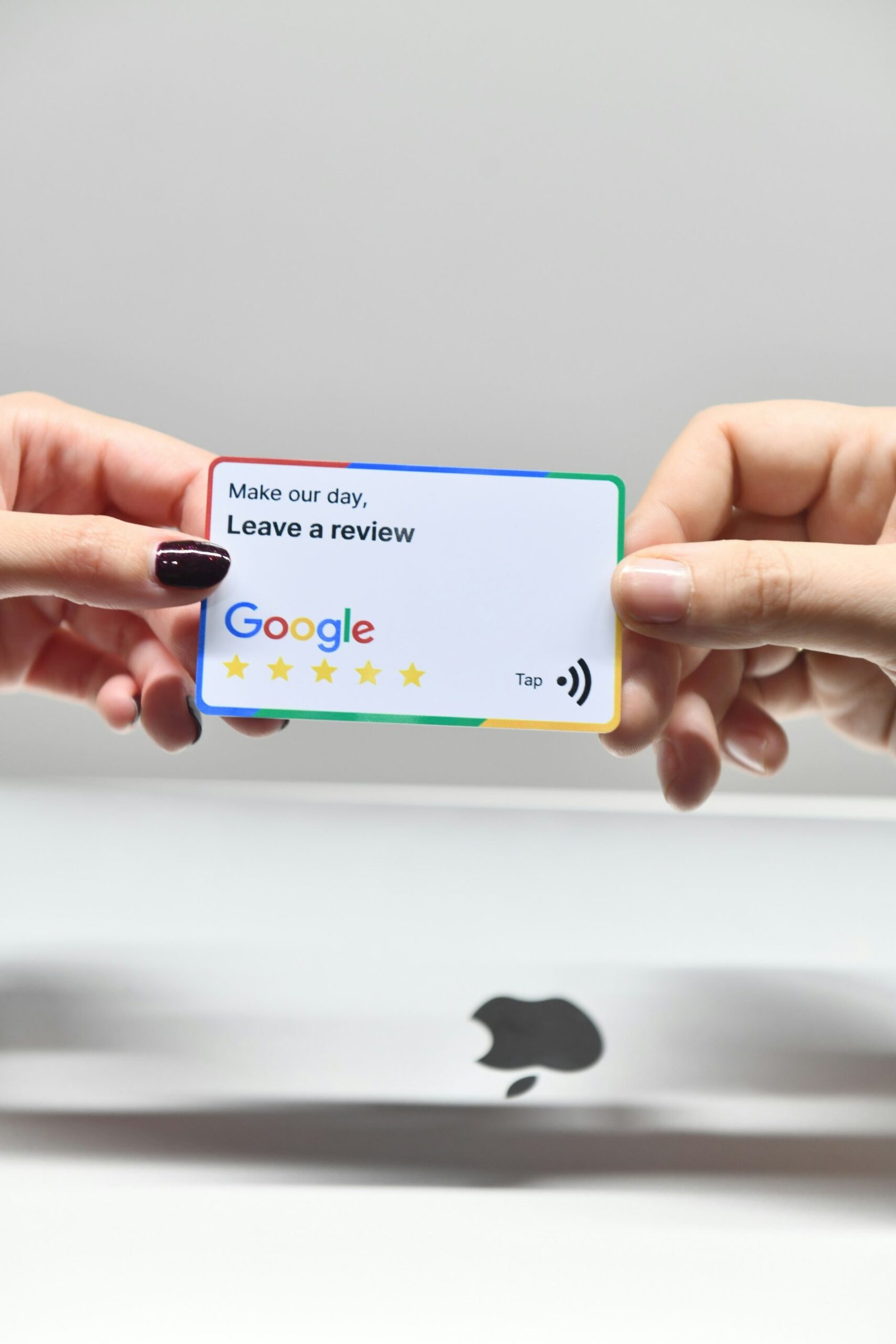
| Make the ask a required step at job close, spoken by whoever finishes the work, in one casual sentence rather than a script. Hand over a card with a QR code to your review page so the customer can act immediately, and tell them a text with the link is coming in the morning. |
The ask has to happen at the point of maximum goodwill, which for a trades business is the moment the work is finished and the customer is looking at it. Not a day later, not from the office, and not in an invoice email. Right there, from the person who did the work, because that is the person the customer feels grateful toward.
It should be one sentence and it should sound like a person talking, because the instant it sounds like a memorised script the exchange gets awkward for everybody, and awkwardness is the main reason crews quietly stop asking. We give the exact wording, along with the follow-up text, in our guide on how to ask for reviews as a contractor.
Two details make this dramatically more reliable. The first is a physical card with a QR code that opens your review page directly, handed over at the same time, which gives anyone who wants to do it on the spot a way to do it in about twenty seconds. The second is telling the customer the text is coming, because it turns the follow-up from an unexpected marketing message into something they were told to expect.
Who actually makes the ask
This is where a lot of systems fail before they start. If the ask belongs to nobody in particular it happens sometimes, so it has to belong to a specific role, which in most trades businesses is the crew lead or technician who closes the job, since they are the only person present at the right moment. That means putting it into how a job gets closed, in the same category as final photos or collecting payment, rather than leaving it as a marketing nicety outside the workflow. Contractors who add it to the job-close checklist get it consistently. Contractors who mention it at a team meeting and hope get it for about three weeks.
Why does the follow-up matter more than the ask itself?
| The follow-up is what converts intent into a posted review. An in-person ask creates willingness, but the customer is rarely in a position to act on it right then. An automated message the next morning with a direct link catches them in a calm moment and removes every step between wanting to help and having helped. |
If you only implement one part of this system, implement this one. The in-person ask on its own produces a trickle. The follow-up is what produces the flow, and the reason is simply that it arrives at a better moment with less friction attached. Sending it immediately is too soon, since the customer is still getting back to whatever the work interrupted, and a week later is too late, since the specifics have faded. The next morning is the sweet spot.
The other half of it is the link. Asking someone to leave a review on Google sounds easy and is not, because it means opening Google, searching your business, finding the right listing, locating the review button, and only then writing something. People drop out at every one of those steps. A direct link that opens the review box removes all of it, and the difference in response rate between the two is not subtle.
What should the review request automation actually look like?
| Trigger the message when a job is marked complete, send it the following morning by text, include the direct review link, and send at most one reminder a few days later. Keep it to one short message with one action, and build it in software you already use rather than adding a tool you will not maintain. |
The automation is deliberately simple, and that is not a limitation. Every additional step is somewhere the system can break, and a review request automation that nobody maintains is worse than none, because it creates a false sense that the problem is handled.
A working setup has four moving parts. The trigger is a job being marked complete in whatever software already runs your scheduling or invoicing, which for most trades businesses is a field service platform or a CRM. The delay holds the message until the next morning. The message itself is a text, because texts get read and acted on at rates email cannot approach, and it carries one link and one request. The reminder is a single follow-up a few days later to anyone who has not responded, and then it stops permanently.
That last point matters. One reminder is helpful and two is pestering, and a customer who feels pestered does not leave a neutral review, they leave a bad one or they remember you as the company that would not stop texting. Set the sequence to end and leave it ended.
Getting your direct review link
You do not need a tool for this. Google generates a shareable review link for every verified Business Profile, available from the profile management interface, and that is the link that belongs in your text and behind your QR code. It is worth testing it on your own phone before it goes anywhere near a customer, because a broken link in an automated message fails silently on every job until somebody notices.
If you do not have software to build this in
Plenty of smaller trades businesses do not run field service software, and that is fine. The system still works with a shared list and a recurring calendar reminder, where someone in the office sends the morning messages by hand from a saved template. It is less robust than true automation and it is the first thing to break in a busy week, but it is enormously better than nothing, and it is usually what a business does for the first year before the volume justifies the software.
How do you shape reviews so they help your ranking?
| Ask customers to mention the specific service and their town, and to add a photo if they can. Google reads review text, so reviews naming the work and the location build relevance for service-plus-city searches. Suggest these lightly. Never tell a customer what to write. |
This is the part that separates a review system that lifts your star rating from one that also lifts your visibility, and most contractors have no idea it exists.
A review saying the work was great and the team was professional is genuinely useful, because it reassures the next person reading your profile. But a review that says you replaced their roof and names the town does something extra, since Google reads the text of your reviews and treats those words as evidence about what you do and where you do it. One such review is noise. Forty of them across the towns you serve is a real local relevance signal, and it is one of the reasons reviews feed the prominence factor that decides Local Pack position, which we break down in our post on how contractors rank on Google Maps. A photo is worth asking for on top of that, particularly for visual trades, because a customer’s own picture of finished work is more persuasive than anything you could produce yourself.
The line you must not cross is writing the review for them or telling them what it should say. That breaks Google’s policies, it is easy to spot in the pattern of your reviews, and it is unnecessary, because a light suggestion does the job. Mentioning that it helps if they say what work was done and where they are is a suggestion. Sending them a paragraph to paste is not.
What is review gating and why does it get contractor profiles penalized?
| Review gating is surveying customers first and sending the review link only to the ones who respond positively. It violates Google’s policies and consumer protection rules because it manufactures a misleading rating, and platforms can remove your reviews or restrict your profile for it. Send the same request to every customer instead. |
This is the practice most worth naming explicitly, because unlike buying reviews it does not feel like cheating. It feels like sensible filtering, and it is sold that way by a number of reputation tools. The pitch is that you survey customers first, and only the happy ones get routed to your Google review link while the unhappy ones get a private feedback form.
It is against the rules. Google’s review policies prohibit selectively soliciting positive reviews, and the practice has drawn regulatory attention in the United States, where suppressing negative feedback to present a misleadingly positive picture runs into consumer protection rules on deceptive reviews. Consequences range from having reviews stripped to broader restrictions on the profile, and the risk sits with you rather than the vendor who sold you the tool.
It does not even serve you well. A perfect record with no critical reviews reads as suspicious to anyone paying attention, while an occasional two-star review among dozens of genuine positives makes the profile more credible. What actually protects your reputation is a steady base of real reviews plus a calm public response when a critical one lands, which we cover in our guide on how to respond to a negative Google review without making it worse. Ask everyone, handle the occasional bad one properly, and you outperform gating with none of the risk.
What else violates Google’s review policies?
| Never offer discounts, gift cards, or any incentive for a review. Never write reviews for customers, post reviews from staff or family accounts, trade reviews with other businesses, or buy them. These can get reviews removed and your Google Business Profile flagged or suspended. |
Gating is the one people fall into by accident. These are the ones people fall into by shortcut, and every one of them puts the profile itself at risk.
- Offering an incentive of any kind, including a discount, a gift card, or entry into a prize draw, which is prohibited regardless of whether you ask for a positive review specifically.
- Writing reviews on a customer’s behalf, even with their blessing and even if the content is accurate.
- Reviews posted by employees, family members, or friends who were not genuine paying customers.
- Review exchanges with other local businesses, which are easy for platforms to detect because the pattern is obvious.
- Buying reviews outright, which is the fastest route to having a profile stripped or suspended.
The consequences are worth understanding in concrete terms. At minimum the affected reviews get removed, which means the effort produced nothing. At worst the profile is suspended, and a suspended profile takes you off Google Maps entirely until you get it reinstated, which is a process we walk through in our Google Business Profile suspension playbook. Trading a genuine local presence for a handful of manufactured reviews is a bad deal in every direction.
How do you run this across multiple crews or locations?
| Give each location its own review link tied to its own profile, make the ask part of job close for every crew, and track review requests per completed job by crew so you can see who is running the process. Hold crews accountable for asking, never for the reviews themselves. |
A system that works with one crew often falls apart at three, and the failure is predictable. One or two crews adopt it, one never does, and the review flow looks acceptable in aggregate while half your jobs produce nothing.
The fix is visibility rather than pressure. If your job records show which crew closed each job, you can see review requests and resulting reviews broken down by crew, and the crew that is not asking becomes obvious in a week rather than a quarter. Usually the reason is simple and fixable, such as a crew lead who finds the ask uncomfortable or never got shown how it is meant to sound.
One caution on accountability. Hold people accountable for making the ask, which is entirely within their control, and never for the number of reviews received, which is not. The moment a crew’s standing depends on review count you have created an incentive to solicit reviews improperly, and you end up with a policy violation created by your own management structure.
Multiple locations
If you operate genuinely separate locations with their own Google Business Profiles, each one needs its own review link, and reviews need to land on the profile for the location that did the work. Routing everything to one profile weakens the others and can create the appearance of reviews for work performed somewhere the business does not operate, which is exactly the kind of inconsistency that draws scrutiny. Keep the mapping between job location and review link explicit in the automation rather than leaving it to whoever sends the message.
Should you collect reviews anywhere besides Google?
| Google first, and by a wide margin, because Google reviews feed Local Pack rankings directly. Once you are competitive with local rivals on Google, add a second platform that matters in your trade. Never split a single customer’s request across platforms, because asking for two reviews usually produces none. |
Google is not one option among several for a local trades business. It is the platform that decides whether you appear in the map results people actually call from, and reviews there are a direct ranking input rather than just social proof. Everything else is secondary until your Google presence is competitive in your own market, and competitive is a relative measure rather than a number. The benchmark is the businesses currently ranking above you for the searches that bring you work, which is why the useful exercise is comparing your review count and recency against theirs specifically, as we walk through in our guide on auditing your Google Business Profile against the competitor beating you.
Once you are genuinely competitive on Google, a second platform can be worth adding, and which one depends on your trade and market. Facebook matters where local recommendation groups drive referrals, Yelp still carries weight in some metros and categories, and trade-specific directories matter more in certain trades than others. The one thing not to do is ask a single customer for reviews in two places, because two requests reliably convert worse than one. If you are diversifying, alternate across customers rather than doubling up on any of them.
How do you know if the review system is working?
| Track reviews per completed job, not total review count. That single ratio tells you whether the process is running. Then watch review velocity over months, and expect ranking movement to lag the reviews by several weeks because local signals compound rather than switch on. |
Total review count is the number everyone looks at and the least useful one for management purposes, because it only goes up and it tells you nothing about whether the system is currently working. A business can have four hundred reviews and a completely broken process.
The number that actually tells you something is reviews per completed job. If you closed forty jobs last month and received eight reviews, you know where you stand and you can watch that ratio move. When it drops, the process has slipped somewhere, and you can find out where before three months of reviews go missing. Alongside it, watch the pace of arrival rather than the total, because velocity is what Google weighs and it is what a stalled system shows up in first.
On results, set expectations honestly. Reviews arrive within days of fixing the process, and ranking movement takes considerably longer, typically a few months, because prominence is built from signals that compound. The lag is normal and it is exactly the point where contractors conclude it is not working and stop, which is the one outcome that guarantees it will not.
What breaks a review system, and how do you keep it running?
| Review systems almost always break during busy season, after crew turnover, or when an automation fails silently. A short monthly check of the reviews-per-job ratio, the automation, and the review link catches all three before they cost you months of reviews. |
Systems do not usually collapse. They erode, in three predictable ways that a brief monthly check will catch.
The first is busy season, which is the cruel irony of this whole subject, because the asking stops precisely when the job volume that would have produced the most reviews is at its peak. That is the entire reason the ask is one sentence and the follow-up is automated, since a two-step process is light enough to survive a week when everything is on fire.
The second is turnover, because a new crew lead who was never shown the ask will not make it and nobody will notice for a month or two. Putting it into onboarding, rather than treating it as something everybody just knows, closes that gap.
The third is silent automation failure, which is the most damaging because there is no signal. A changed review link, a disconnected integration, or a workflow that stopped triggering after a software update produces exactly the same experience as everything working, right up until someone checks the numbers. Send yourself a test message once a month and tap the link. It is the cheapest insurance in this entire system.
Frequently asked questions
How many Google reviews does a contractor need?
There is no fixed number, because what matters is how you compare to the contractors ranking above you in your own market. A business competing against rivals with thirty recent reviews needs a different position than one competing against rivals with three hundred. More important than the total is recency and consistency, since a steady flow of new reviews signals an active, trusted business while a large total that stopped growing signals the opposite.
Is it legal to offer customers something in exchange for a review?
Offering incentives for reviews violates Google’s review policies and can get your reviews removed or your profile restricted, and in the United States it also runs into consumer protection rules around deceptive reviews. This applies to discounts, gift cards, and prize draws, and it applies whether or not you ask for a positive review specifically. Ask because you did good work, which is both compliant and more effective.
What is review gating and why is it a problem?
Review gating means surveying customers first and sending the review link only to those who respond positively, while routing unhappy customers to a private form. It violates Google’s policies against selectively soliciting positive reviews and can result in reviews being removed or the profile restricted. It also backfires commercially, because a flawless record reads as less credible than a strong one with the occasional critical review handled professionally.
Should I automate review requests or ask in person?
Both, because they do different jobs. The in-person ask at job close creates the willingness while the customer is happy with finished work in front of them, and the automated follow-up the next morning converts that willingness into a posted review by arriving at a calmer moment with a direct link. The in-person ask alone is forgotten, and the automated message alone feels impersonal. Together they are what makes the system work on every job.
How long before reviews improve my Google ranking?
Reviews start arriving within days of fixing your process, but ranking movement usually takes a few months, because Google’s prominence signals compound rather than switching on. The reviews accumulate first, the velocity signal builds, and the ranking follows. This lag is the most common reason contractors abandon a system that was about to start working, so the practical advice is to measure the process monthly and judge the rankings quarterly.
The bottom line
A review generation system for contractors is not a clever script or a piece of software. It is four things done consistently: a one-sentence human ask at job close, an automated follow-up the next morning with a direct link, a light suggestion that the customer mention the service and their town, and a short monthly check that the whole thing is still running.
Everything else here is detail around those four. Ask every customer rather than filtering for the happy ones, keep well clear of incentives and anything else that puts the profile at risk, make the ask part of job close so it survives busy season, and measure reviews per job rather than staring at a total that only ever goes up.
Do that and you get a steady flow of recent reviews naming your services and your towns, which lifts your star rating, your Local Pack position, and your visibility on the service-and-city searches that turn into work. The alternative is relying on customers to remember a favour on their own, which is how a decade of excellent work ends up sitting behind six reviews.
If you would rather have this running without building it yourself, we set up review systems for trades businesses, including the automation, the links, and the tracking. Request a free local visibility audit and we will show you where your reviews stand against the contractors ranking above you, and what a system like this would look like for your business.
You can contact us at:
Email: contact@gravitymktg.com
Phone Number: +1 (406) 309 7969